
Combustion reaction by Doris Kra

Doris Kra
05/03/2019
Chemistry
Miss. Block
                                             What is a combustion reaction
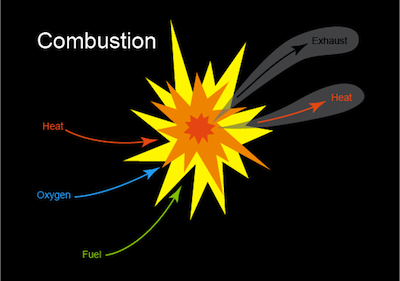


(b)
Some examples of a Combustion reaction are:

  • Combustion reaction of Methane                                                                                                     CH₄(g) + 2 O₂(g)→ CO₂(g) + 2 H₂O(g)
  • Combustion reaction of Propane                                                                                                      2 C₃H₈(g) + 7 O₂(g) → 6 CO₂ (g) + 8 H₂O(g)                          
  • Combustion reaction of Ethane                                                                                                        2 C₂H₆ + 7 O₂→ 4 CO₂ + 6 H₂O
Citations

a) https://www.google.com/search?q=combustion+reaction&rlz=1CAKSOU_enCM687CM716&source=lnms&tbm=isch&sa=X&ved=0ahUKEwjZkLTA4-vgAhVbRhUIHcV6AM0Q_AUIDigB&biw=1300&bih=572#imgrc=08oruGJQRM7f7M:

b) https://media1.shmoop.com/images/chemistry/chembook_stoich_graphik_22.png


Comments

Popular posts from this blog

What are covalent bonds and why are they important

                              Covalent bonds A covalent bond also known as molecular bound is when two nonmetals share electrons. The bonding starts forms when the electrostatic attraction of their nuclei are aiming for the same electrons. Atoms will share electrons with other atoms to be stable,  stability is gained by filling their electron shell, and each shell except for the first one needs 8 electrons to have a full shell. For example, Co2, carbon bonds covalently with 2 oxygen to have a full outer shell, oxygen needs 2 electrons to have a full outer shell and carbon, and carbon needs 4 more electrons for a full outer shell, so its going to bond with the oxygen and both elements will be stable. Due to the sharing of electrons, they show physical properties  that include lower melting points and lower  electrical conductivity  compared to ionic compounds .  There are two ...

Precipitation

Precipitation Precipitation is any forms of particles, whether liquid or solid, that Precipitation reaction leads to a reaction  that leads to the formation of a heavier solid in a lighter liquid. Precipitation is basically any product of the condensation of the atmospheric water vapor that falls under gravity. This occurs when a portion of atmosphere becomes saturated with water vapor. There are two processes, possibly acting together, can lead to the air and it becomes saturated. Cooling the air or adding water vapor to the air. Precipitation  forms as smaller droplets coalesion with other rain drops or ice crystals within a cloud. Short periods of rain  in scattered location are named showers. An example: Mixing silver nitrate and sodium chloride in water will cause silver chloride to precipitate out of   solution   as a   solid . In this example, the precipitate is silver chloride. When writing a chemical reaction, the presence of a precip...

Displacement reaction

A chemical reaction is when one or more substances which are reactants are changes into one or more different substances which then becomes the product.  A chemical reaction is written with the formula of reactants on the left side, and formula of the products formed on the right. An arrow is placed in-between the reactants and the products. They are 5 types of chemical reaction; Synthesis reaction/combination Decomposition Reaction Displacement or Replacement Reaction Acid Base Reactions Combustion Reaction I'll be explaining one of these five reaction which will be  Single displacement reaction .  Single displacement reaction is part of the reaction "Displacement or Replacement Reaction. Single displacement reaction happen when a cation(positive) and an anion(negative) swap from a compound.  The general formula for a  single replacement reaction  is A + B-C → B + A-C where  A  is an element and where  B-C  is a c...